Sunday, September 15, 2019

rambling on some politics

California passed some bills last Monday that make me pretty frustrated, to put it lightly. Honestly, they have maddened me beyond comprehension, and I have spent the week trying to figure out how to adequately express my thoughts about it. 

These bills are “about” a pretty big buzzword … vaccines.

But are they, really?

NO they are about medical freedom. 

I can’t comprehend the idea behind telling someone else what they legally HAVE to put into their body. Or their children’s body.

I CAN comprehend having the choice to do so, and I can comprehend why some make the choice to do so.

But what of stripping that choice away?

California has zero vaccine exemptions valid for children to attend school. There are three types of exemptions, and many other states have some combination of the three, but California just joined New York, West Virginia, and Mississippi to disallow any exemptions.

Personal exemptions were the first to go. You couldn’t just say “I don’t want to.” Religious exemptions were gone following SB277 in 2015. You couldn’t say “It’s against my religious beliefs.” What got taken away last Monday? MEDICAL exemptions. You can no longer say “My child had a reaction to a vaccine so we have consulted with our doctor and have jointly come to the conclusion that my child should not receive any more, for fear there will be another reaction, potentially fatal.” Or “Our family has a history of autoimmune diseases/vaccine reactions/MTHFR gene mutation/etc so upon consulting with our doctor we have decided it is too risky to vaccinate.” SB276 and SB714 have determined that doctors can no longer give more than 4 medical exemptions in a calendar year. And any that they do give must be reviewed by some still-to-be elected official to give the final say. And the final say is almost always going to be “exemption denied,” because the parameters for a medical exemption are now so small that you basically have to already be dead from a reaction before you can maybe receive the exemption.

So the STATE- some elected official working out of an office in Sacramento, who has never met any of the children whose medical exemption pleas pass through his/her desk, can decide that he or she disagrees with the DOCTOR- who has likely seen said children from birth, knows the family, knows their history, cared for sicknesses, has some semblance of knowledge of the child- this state official can decide that he or she disagrees with the medical recommendations from the doctor and the child does not need a medical exemption and must be fully vaccinated in order to attend/continue to attend any public/private/charter school in the state. 

Oh and any doctor who tries to issue more than 4 medical exemptions in a calendar year will automatically be put under review by the state. So now we have a state full of doctors who are going to be terrified of writing ANY medical exemptions (not that they haven’t been already). 

Goodbye doctor-patient relationship. 

Goodbye medical choice. My body, my choice … only valid for so much it seems.

Land of the free, home of the brave?

Wednesday, May 22, 2019

You're Okay

I have a video of Harrison from a long while ago when he was first starting to crawl. He’s inch-worming himself to a bottle of kombucha (haha) and every time he gets close enough to touch it, I move it a few inches out of the way. A simple, fun game that we were both enjoying. I love this video up until towards the end- Harrison starts to get a bit fussy, either from overwhelm, or getting tired from working so hard, and I say to him “You’re okay!” in a peppy voice. I hear that, and every time I wish I could have a do-over. 

It’s innate in our psyches, isn’t it, to pass over or pass off a young child’s emotions. We try to calm babies by shushing them and telling them they are okay. When a toddler falls and scrapes his knee, we try to keep him from crying by telling him he’s okay. When a child is acting frustrated if something isn’t working out the way she wanted it to, we try to get her mind off of it by telling her it’s okay. It’s okay. You’re okay. It’s okay. You’re okay.

It’s a phrase I’ve successfully removed from my vocabulary with Harrison and Dylan, and in doing so I have become hyper-aware of how often it gets used. It just rolls off our tongue, without thought or effort. It seems to be always there, waiting for the first sign of displeasure, but why?

If my child is upset about something, clearly he is not okay. So if “you’re okay” is the first phrase we reach for, perhaps we are uncomfortable sitting with the emotions of our children. And sitting with emotions in general- yours, mine, ours.

I decided to remove the phrase from my parenting arsenal because I find “You’re okay” to be very dismissive of how my boys are actually feeling. Rather than being dismissive, I prefer to acknowledge. I try to not be long-winded about it; simple acknowledgement goes a long way.

If Harrison falls and hurts himself, I get down on his level and we talk about what happened. “You fell down. That hurt, didn’t it? Maybe it was a little scary too? It’s okay to cry. I’m right here for you.” If he’s overwhelmed by a task he’s set out for himself- like building blocks that keep falling down, or trying to keep a book open to a particular page- I talk to him about what is going on. “Those blocks keep falling down and you want them to stay up.” “That book won’t stay open to the page you want.” Followed by “That feels really frustrating, doesn’t it? It’s okay to feel frustrated. Do you want to try to figure out a different way to build the blocks/keep the book open?”

It’s simple, it’s acknowledging, and I think it’s healthier for him as he grows in to a young man. Hopefully he can use this as a foundation to accept and healthily express his emotions, and accept the emotions of others. Jeremy and I have seen this approach reap positive behavior already as Harrison is in his toddler years. He uses his emotions, along with the space he is given, to process through whatever difficult event he has encountered. Generally within a short minute or two he has worked through it and is happily back at whatever he was doing.

And what of my baby, my sweet 5 month old Dylan? While he’s truly the most easy-going and cheerful baby I’ve ever known, he certainly has more emotions than happy or cheerful. He cries in the car seat. He gets angry in the baby carrier. He lets me know if he’s hungry. And when we encounter these moments of unease, I let him know I hear him and am trying to understand what is bothering him. “You’re not happy to be in the car seat right now. I see you’re having a hard time, you don’t like this.” “You really want to be put down right now. I hear you. I can see how upset you are.” “You are feeling really hungry right now! I would be angry too if I felt that hungry.” Or the like. And I have been able to use these moments with Dylan as teaching opportunities with Harrison as well. “Dylan is not acting happy. It seems like he doesn’t want to do tummy time anymore and wants some help.”

This little change in my vocabulary has helped me as well to be accepting of the whole range of emotions we can feel. By accepting and acknowledging the “positive” along with the “negative” emotions of my children, I’ve found myself better able to accept those emotions in Jeremy and my family and friends, and sit with them in however they are feeling; little by little it’s also been helping me to accept my own emotions, and own them, and truly feel them and express them in a healthy way. 

If this has intrigued you at all, next time you find yourself about to say “it’s okay” to anyone- a baby, a child, a peer, yourself- try this instead:

It’s okay. “It’s okay to feel ______.”

***

On a side note, I found myself a while back almost comically unable to name any emotions outside of “happy” or “sad.” It was a telling moment for me, and the advice I was given was to look up an emotion wheel (for example). It’s not that other emotion words were outside of my learned vocabulary, but by seeing them laid out in this form it was a great help in pinpointing my feelings and using that newfound self-awareness in my marriage and parenting and friendships.

Friday, January 25, 2019

Christmas 2018

I’ve heard of these magical fairy unicorn pregnant women, the ones who wake up one morning having no idea their baby will be in their arms at the end of the day; the ones who go into labor without much forewarning and barely have time to call their midwives or make it to the hospital before the baby is born; the ones who want a natural birth and get to adhere to their birth plan and feel every beautiful and difficult part of labor and birth. I knew these women existed, and I never expected that I would have such an experience. Harrison’s birth, beautiful in its own way, was far from the magical unicorn experience mapped out above. He was born in the hospital, after I labored naturally for 48 hours at home and 13 hours in the hospital with an epidural and Pitocin and antibiotics and who knows what else. I had his birth to go off of and visualize as I made my way through 40 weeks of pregnancy with our little Kozling #2. I was fully aware that most second-time (and onward) pregnancies can result in shorter and more efficient labors, since the body has already done it once and so in essence already has everything figured out. And so with that knowledge, I would mention to people that I was holding space for a six hour labor- partially joking, as six hours just felt so short to me and I didn’t truly know if my body would handle labor that way. I figured anything shorter than 2.5 days would be great, or any length of time at all if I my baby could just be born at home. I did have trust in my body, but I was also trying to be realistic.

So when Christmas Day came and Braxton Hicks contractions started to become more frequent in their occurrences that morning and afternoon, I thought nothing of it. We opened presents with Harrison that morning and FaceTimed with both sides of the family- naturally fielding questions about how I was feeling, and not mentioning the Braxton Hicks because I didn't think they needed mentioning- and decided to go to the beach in the early afternoon. It was cold and windy in Playa del Rey, but we had a lovely time with Harrison, digging in the sand and making tunnels for his new toys, and appreciating the beauty of being outside. 


And so there I was at the beach, on the day of my baby’s birth, having no idea what was in store in just a few hours.

This was 5.5 hours before baby was in my arms. Look how unassuming I am!

Since our due date was Christmas Eve, we had no plans for celebrating Christmas. So, after the beach and some lunch, we walked from our apartment to a nearby park in the late afternoon. While there, the Braxton Hicks contractions started to occasionally have some minor cramp-like sensations associated with them. These feelings were far from unmanageable, and once again they were not unfamiliar feelings, as I had occasionally felt them over the previous weeks. So I thought nothing of them.

We walked home from the park around 4:30 and chatted about ordering takeout when we got back home. On that short walk I began to realize that I needed to start focusing on breathing through the cramp-like sensations, Once we got home I decided something *might* be happening, and as Jeremy was headed out the door around 5pm to pick up our dinner, I offhandedly mentioned that he should park on the street when he got home, so that our parking spot would be open for someone from our birth team, on the off chance I went in to labor that night. I kept Harrison busy for the 30 minutes that Jer was gone, and at the same time those crampy sensations started turning in to something I couldn't talk through. I remember sitting on the couch with Harrison reading him "One Fish, Two Fish" and needing to pause and stand up and work through each contraction while trying to make it through the book. 

And then Jeremy came home and I couldn't sit down and eat the take out that had sounded so good just an hour previous, and I couldn't have a two minute conversation with Jer without pausing to work through a contraction. He told me I needed to call our midwives (5:30pm at this point), and he emailed his work to let them know he wouldn't be in for the week ahead. And then I told him he was jumping the gun and shouldn't have emailed work so soon. I mean come on you guys, baby was literally born two hours later and I still wasn't convinced I was in labor.

I chatted with one of our midwives at 5:50pm and let her know the specifics of the events of the day and our parting words had to do with keeping in touch with her over the next few hours and we'd decide whether or not she needed to come over that night.

Fast forward to ten minutes later when I called my Mom to let her know that perhaps I *might* be in early labor but I wasn't sure yet. And I mentioned the realization that if baby was born in under six hours, it would be a Christmas baby. And in that two minute conversation with her I had to stop talking and work through two separate contractions, and then my waters broke. What?!

Let's just stop and consider the fact that I had to push for HOURS during Harrison's birth before my waters broke, and here I was standing in my bedroom, casually chatting on the phone with my Mom, and there it happened out of the blue, just like in the movies (except not just like, aside from the seeming spontaneity of it all).

Jeremy was trying to finish giving Harrison a bath, and went back and forth between the two of us to help me whenever I went through a contraction. My waters were a funky color and my midwife decided she needed to be there sooner than later so she started making her way over. The last text I sent my doula, after we determined she'd come between 7:00-7:30 (to help me while Jeremy got Harrison down for bedtime), was that she could take her time since our midwife was on the way. So yes I finally realized I was in labor, but all of this planning- Harrison's bedtime, not needing to rush anyone over- is kind of comical to look at in hindsight.

Our first midwife arrived around 6:45pm and a few things happened very quickly:
1. It was determined that I was 10cm already. 
2. She had come into the apartment in a rush and without her birthing supplies, and I vaguely remember her going back to her car to get the supplies and telling Jeremy to call her if he saw baby's head crowning. 
3. The color of my waters meant that I needed to go to the hospital, as home-birth midwives are not equipped to deal with the potential ramifications of waters not being clear. (AKA, baby had a bowel movement in utero and if baby aspirated meconium while I was in labor there could be very detrimental effects.) 

The only coherent words I could get out in between contractions at that point were "There's no way I can get in a car right now," and "I'm so flabbergasted!" 

Birth was imminent, which meant that more than likely our baby would have been born in an ambulance if we decided to go to the hospital. In the end, no decision was actually made concerning whether or not to stay home or call 911. Labor just kept on happening. I dug deep and told my baby that we were going to be just fine. It really could have gone either way, but that baby was coming out FAST and we just kept on keeping on.

My doula arrived around 7pm, having no idea that things had progressed so quickly. She came not a moment too soon, and I then clung to her for the next half hour in what was likely a death grip. She was such a light, such a calm presence, by my side for the rest of labor. Jeremy continued to alternate between me and Harrison (lol on the idea of Harrison going to bed by 7:30 that night!), and he stayed by my side for the end of it. Harrison came in and out of the room, giving me kisses and hugs and was unfazed by everything that was going on.

And then, just like that, at 7:39pm, my baby was born. And with baby's arrival was the most earth-shattering, BEAUTIFUL cry that I have ever heard. The loudest healthy cry. Clear lungs. A healthy baby, placed into my arms immediately while I sat in a wave of happy hormones, Jeremy's arms around the two of us, and Harrison wandering in to the bedroom, looking at us, and adorably voicing "Baby!" Oh, my heart, in those moments.

I then was able to lay down in the comfort of my own bed with my baby in my arms and relish in the moments that had just happened, with the two other people I love most in this world right by my side.


Baby came into this world the evening of December 25th, after three short hours of labor (mentally I didn't even realize I was in labor for the first 1.5 hours. It was quite the whirlwind.) It's been a month, and while naturally there have been ups and downs, I am still relishing in the beauty of our family of four.


In true Jeremy and Bekah fashion, we had still not agreed on a boy's name by the time I gave birth. We took a few minutes to get to know our little one before checking to see if we had a boy or girl, and when Jer finally checked, his laughter said it all. Another boy. Another precious little boy.


We finally decided on a name a few days later. So, world, meet Dylan Asher, one of the most laid-back babies I've ever met. He was born at 7lbs even and measured 19.5 inches long.


He will wear all of Harrison's hand-me-downs but is already very uniquely his own person. 


Harrison loves him like no other, and we do too. Our hearts doubled in size the moment Dylan was born, and it's hard to remember our family feeling complete without him.

The best people

Monday, July 30, 2018

Harrison is a Big Brother

We are a family of four now, our newest little Kozling growing inside my womb for the next few months before we meet him or her earth side. We are elated to be adding to our family, and the miracle of growing a tiny being will never be lost on me.

Since my recent posts have shifted to be about our family’s more natural lifestyle, I have decided to continue on that topic and write about how we are going about this pregnancy, which is essentially identical to how we went about my pregnancy with Harrison. Read: very hands off.

***

When I first became pregnant with Harrison, I would tell anyone who would listen “do this, not that, when you are pregnant.” “Do this, not that, when you are in labor.” “You definitely do NOT want to do that!!” As I went through pregnancy I realized in hindsight how uncaring and unkind I had been in those (one-sided) conversations. And as Harrison has been growing up, I’ve become more and more aware of ALL OF THE MOM-SHAMING that goes on in our world. I’ve since learned (tried to learn) to tame my words, and to not tell people what to do. We all have our own version of what works for us, and what we hope for in pregnancy and labor and birth, and this blog post encompasses what I’m doing to try and achieve my hope, my ideal pregnancy, labor, and birth. The lifestyle I live is a passion of mine and so yes I will keep talking about it. Because it works for me and I want to share it with the world. And I'm doing my best to share it in such a way that makes it clear I have no judgment for those who choose differently. This is me doing me. You do you.

***

We had the most wonderful set of midwives for my pregnancy and birth with Harrison, and we are so happy to be able to work with one of them again for this pregnancy, along with her new colleague. We are once again planning for a home birth, in the same one-bedroom apartment we’ve been living in for over four years now. If you’ve read my birth story with Harrison, you may recall we ended up transferring to the hospital after close to 48 hours of labor- once it became overwhelmingly clear that my body needed intervention to open up past 7 centimeters. And while our time at the hospital was generally positive, we are hopeful that we can actually stay at home this time and that Harrison will be with us to welcome his sibling into the world.

Working with midwives and planning for a home birth are very conscious decisions for us- we know (and have experienced) that the closer we get to the medical model of birth, the more interventions will be asked of us or coerced on us. We believe that pregnancy and birth are fundamentally natural processes and we thoroughly appreciate going through them with a team of individuals who are like minded. Our midwives provide us with plenty of scientific and evidence-based information about all the choices we have during this process, and we are supported in the choices that we make based off the information.

So what are the choices we are making?

We are not doing any ultrasounds. This includes turning down the option to hear our baby’s heartbeat with a doppler. We believe that the safety of these options is overstated and that they are overused. Here are two blog posts on the subject from sources I trust: here and here(This coming from the person who turns the WiFi off at night, uses a radiation-blocking cellphone case, and has never gone through the x-ray scanner at the airport. I do my best to walk my talk.) We felt it was definitely unnecessary to have an ultrasound done to confirm our pregnancy when the baby was just a few weeks gestation- a urine and blood test had already confirmed it. Later in pregnancy our midwives are able to determine our baby’s health and position based on palpating my stomach and keeping track of my fundal height, and eventually feeling the baby and gauging the amount of amniotic fluid. We are perfectly happy to wait until around 20 weeks (give or take) to hear the baby’s heartbeat through a fetoscope (like a stethoscope, but specifically designed to hear a baby’s heartbeat in the womb). I trust inherently in my body, and hearing the heartbeat (or not hearing it, for that matter) would not and does not change the course of my pregnancy. If we wanted to find out the gender of our baby, we could do a blood test rather than an ultrasound. But we enjoyed the surprise when Harrison was born, and we are happily anticipating that moment again with our newest little one.

We are forgoing all invasive tests. An amniocentesis is definitely out of the picture as we see it unnecessarily dangerous. We will also forgo internal checks that can become routine towards the end of pregnancy; I don’t need to know if I’m one centimeter dilated at 39 weeks, it would just make me anxious and it would lead to more checks. Once I’m in labor, one or two checks are fine if seen to be necessary. Really it’s pretty easy to tell how far someone has progressed through labor when she is unmedicated. Any time you have an internal check you increase the risk of introducing foreign bacteria into the very environment your baby will be passing through.

I made my stance on vaccines clear in my last postbut to reiterate- we are declining all vaccines. The standard vaccines offered to pregnant women are the Tdap and the Influenza vaccine. Unfortunately these are routinely given without informed consent- has any care provider ever taken out the insert of either of those vaccines and shown their pregnant patients the lines that read “safety and effectiveness of this vaccine has not been tested in pregnant women”? There is also casual evidence to suggest the flu vaccine can cause miscarriages or early labor. I hesitate to write that because, as stated in the inserts, no safety studies have been done so there is no “scientific” evidence either way, and so I have no studies to cite. But the stories are out there in droves.

And I totally am not doing the glucose test that every pregnant woman seems to dread. Have you ever looked at the ingredients in that drink? There is no way I will ever allow those ingredients in my body, ESPECIALLY when I have a baby growing in me and relying on me for all of his or her nutritional needs. I have the option of declining testing for gestational diabetes altogether, or I can track my levels with an in home blood prick for a set amount of days, or I can eat a specific number of specific organic jellybeans in lieu of the drink. We declined testing altogether when I was pregnant with Harrison, due to my overall good health. I imagine we will decline it again this pregnancy, but we haven’t discussed it yet.

What are we doing then?

Non-invasive tests are fine by us if it’s helpful information. Blood tests for my vitamin/mineral levels are great information. Urine tests are non-invasive and provide helpful information as well. I am keeping myself as healthy as possible through diet and exercise. First trimester was rough this time around (after being mostly a breeze with Harrison), and I lived on carbs, cheese, and refined sugar for far longer than I care to admit. I’m currently in the blessed bliss that is second trimester, and my diet has gotten much better. I’m taking a few extra supplements- this very clean prenatal vitaminBlood Builder due to low iron (not as clean as I'd prefer, but it is a decent option), continuing with this cod liver oilmagnesium (as well as using this magnesium lotion to help avoid leg cramps), and this probiotic specifically formulated for healthy flora in the birth canal. I’m eating fermented foods (a far better source of probiotics than any pill), drinking raw milk, “eating” chicken liver (read: freezing it and then swallowing pill-sized pieces), and including plenty of healthy fats in my diet. I generally walk a minimum of three miles per day, and I’m actively aware of my posture and movements throughout the day while I’m playing with Harrison. I’m doing my best to drink plenty of water, which is my primary source of hydration. 

Additionally I am seeing a chiropractor throughout the course of my pregnancy- a chiropractor who has specific interest in and extensive experience working with pregnant women and who does craniosacral therapy as well. This is beneficial in so many ways; keeping my body aligned so I am carrying this baby the best way possible, helping my spine and pelvis adapt to the many changes my body is going through, and generally helping my body AND mind feel GOOD. It is also so beneficial to help my baby stay in the best position for birth as he or she continues to grow and especially when I approach the later weeks. I was feeling so rough before my first chiropractor appointment this pregnancy and simply felt like gold afterwards. I treasure the appointments I have with my chiropractor and know without a doubt it is some of the best self-care I can implement.

—- —- —-

So ... off we go on another adventure!

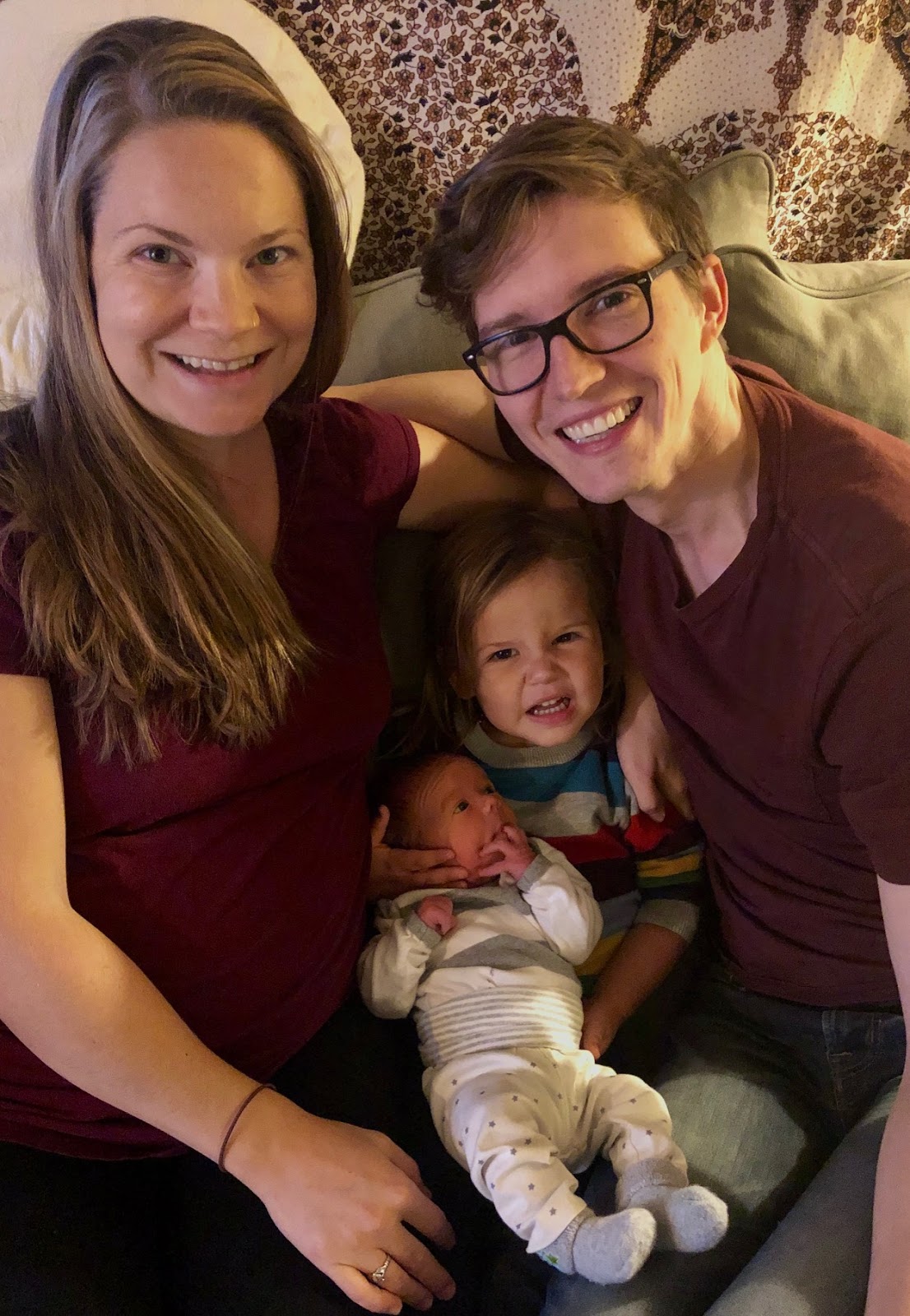
Kozeluh family of 4, picture taken a few weeks ago on my birthday.

Monday, May 28, 2018

Our Family and Vaccines

Shortly into my pregnancy with Harrison, Jeremy and I were faced with the beginnings of the decision whether or not to have him receive any vaccinations, like any other parent. The first form of this decision came when I was provided information about receiving the flu shot while Harrison was still in my womb (after all, anything I received, he would receive as well.) It ended up being a very simple decision, and I declined. The package insert on the flu vaccines clearly states that they have never been tested on pregnant or nursing women. Decision made. Here are the package inserts from four variations of the flu vaccine: 1, 2this particular insert specifically states that the safety and effectiveness has never been tested on pregnant or nursing women and pregnant women who receive it should be added to a particular registry, presumably so that reactions can be tracked since the product hasn't been tested for that demographic before being put on the market: 3, 4.

I don’t remember if the Tdap was offered to me while I was pregnant, but I know that if I had been meeting with an OB in a general hospital setting, it definitely would have been, and I would have turned that down as well. My body was working so hard to grow a tiny human, and I didn’t want anything getting in the way of my body’s natural health. Not to mention that section 8 of the Adacel insert clearly states “It is not known whether Adacel vaccine can cause fetal harm when administered to a pregnant woman or can affect reproduction capacity. Adacel vaccine should be given to a pregnant woman only if clearly needed.” (5) The same goes for BOOSTRIX (6), and both inserts mention a registry to add the names of pregnant receivers to. Putting something unnatural into my body that has not been properly tested for my demographic, and/or has not withstood the test of time, was not and is not something that I am comfortable with.

So anyway, enough about me. What about my newborn baby?

Declining the vitamin K shot at birth was an easy decision- that injection has a black box warning (7), explicitly stating that it has caused "severe reactions, including fatalities." Harrison did, however, receive a few oral doses of vitamin K on a schedule prescribed by our midwives, who continued their in-home care through 6 weeks post-partum. Having that support was instrumental in the confidence we had in Harrison's overall health- vaccines or not. (For what it's worth, we also declined the eye ointment, erythromycin, that is standard for newborns, since it is given to prevent the transmission of an STD from mother to baby and we had no worries about that. We also easily declined the standard Hepatitis B shot since the only ways Hep B can be transmitted are through shared needles or sex.)

Jeremy and I initially decided to wait on making a solid vaccine decision until Harrison was 18 months old. That age was based on my mistaken knowledge that the blood-brain barrier closes right around that time, and so in my mind and in my early thoughts, that meant the vaccine ingredients wouldn’t have access to Harrison’s brain if he received them after he turned 18 months old. In that year and a half of waiting/researching, I found differing information that the blood-brain barrier is closed at birth or that it closes at three years. So admittedly I was mistaken, but thanks to that mistake I was granted more time to search and research and I learned about two tricky ingredients that are in many vaccines- Polysorbate 20 and Polysorbate 80. These ingredients purposefully OPEN the blood-brain barrier and allow for the flow of other ingredients into the brain (8). That was more than enough to give me pause. What were we allowing into the brains of our healthy children?

The CDC has a handy PDF that lists the ingredients in vaccines (9). I was surprised, in perusing that list, to find ingredients like aluminum, MSG, formaldehyde, and monkey kidney cells, to name a few. 

I stopped using aluminum to cook with years ago, and stopped using deodorant with aluminum years before that. Aluminum is a known neurotoxin. (10) It builds up in the body and can cause inflammation and can take years and years and years to filter out, if it does at all. (11also in 10) Inflammation anywhere in the body can lead to an entire host of issues. (12High levels of aluminum have been found in the brains of Alzheimer's patients. (13) Additionally, it is interesting to note that the FDA has mandated that the highest amount of aluminum allowed in IV bags is 25mcg per liter (14), yet vaccines have anywhere between 125-850mcg of aluminum in one dose. One example is Pediarix (15), one of the options for Dtap, which is given “as early as 6 weeks old.” You can scroll down to line 405 to see that it contains 0.85mg of aluminum, or 850mcg. That said, I wasn’t comfortable with the idea of having even trace amounts of aluminum injected into my baby and giving it full access to his body, including his brain. (16)

MSG is something else I already purposefully avoid in my day-to-day life, so why would I give it access to the bloodstream of my child? MSG is also a known neurotoxin and thankfully it has gotten a bad rap, finally, over the past little while. The glutamate in MSG is an excitotoxin. Here is a study that states “glutamate excitotoxicity has been implicated widely in the pathogenesis of a range of neurological diseases including Alzheimer’s disease and Huntington’s disease.” In this study it was successfully used to kill off stem cell neurons. (17) Here is some information about what can happen in the brain when neurons die: 18.

Also of note in that study- the stem cell line used was derived from human embryos. Science is full of moral questions-  what should be allowed or acceptable and what should not. It can be tricky, especially as I believe our culture today is so far from any type of conservatism that it seems as though anything goes, and if you disagree you are ostracized. I’m not here to argue about stem cell research. I simply bring it up to lead to the next two vaccine ingredients I found to be questionable- WI-38 (19), MRC-5 (20). 

These are cell lines derived from aborted fetal cells. 

And there's where I draw a firm line. 

I am pro-life and this is something I cannot stand for. The Vatican has hesitantly decided it is okay (21), but the Vatican is not my God. And for the argument that these particular abortions happened so many years ago that it no longer matters? Don’t even get me started on that, and realize that regardless, there are continually more of these cells being developed the same way. Most recently, there is Wal Vax 2, developed in China as a hopeful replacement for the rapidly declining MRC-5.  Wal Vax 2 comes from one of nine aborted babies purposefully born alive in the sac and dismembered alive in order to harvest their organs while there was still life in them. (22) That's one case, and you can check out the Canadian Journal of Medical Science, Vol. 30, pg 231-245 if you want to read some gut-wrenching accounts of early gestation human embryos arriving in labs with their hearts still beating. If the future of our world is on the backs of the unborn who aren’t given a chance to live in it, count me out.

Questionable morality aside, no tests have been done on the safety of fragmented DNA being injected into our bodies, and there is plenty of anecdotal information about the negative effects these ingredients have on us. Some hold the argument that since they are the host material for growing the virus or bacteria used to make the vaccine they don't end up in the actual vaccine. This argument is invalid, as stated on the CDC's website. "Vaccines also may contain very small amounts of the culture material used to grow the virus or bacteria used in the vaccine." (23) 

Additional culture materials used to grow viruses and bacteria for vaccines, and consequently ending up in the vaccines themselves, include monkey kidney cells, bovine serum, Vero cells (from the African green monkey), chicken eggs, human albumin, insect cells, canine kidney cells, and mouse brains, to name a few. (24) While I'm on the topic, do some research in to the SV40 virus, which is an emerging pathogen that is associated with three different cancers and non-Hodgkin's lymphoma. Did you know that up to 30 million adults and children in the United States may have been exposed to SV40 from 1955-1963 due to contaminated polio vaccines? These vaccines were grown on kidney cells from rhesus monkeys, and these monkeys are often naturally infected with the SV40 virus. The Institute of Medicine concluded that “the biological evidence is of moderate strength that SV40 exposure from the polio vaccine is related to SV40 infection in humans.” (25) Moderately-strengthned evidence is enough to give me pause and wonder what else could be accidentally passed through vaccines via the culture material they were grown on.

And since I am on the topic of the role that animal ingredients play in vaccines, any hardcore vegans or animal rights activists need to also look up the link between vaccine-making and the blood of horseshoe crabs. One image of the process will chill you to the bone, it’s certainly one I’ve not been able to get out of my mind.

After coming across all of the above information, I had to keep looking. As a resident in California, not vaccinating is a HUGE deal. There are plenty of us who do not, but for that decision, our children are currently denied the right to an education in public or private school. (26) This is abhorrently ridiculous, but not the purpose of this blog post. It was just one more consideration in our research journey.

This one's for you, California. Proudly displayed outside the city hall in Culver City.

With further research, I learned about the National Vaccine Injury Compensation Program that was established in 1986 through the National Childhood Vaccine Injury Act, passed by Congress. This Act was put in to place when vaccine makers were being sued by parents for vaccine injury and the parents were WINNING these lawsuits. It was established so that vaccine makers have ZERO liability for the vaccines they produce. Zero. In an age where McDonald’s is liable for its scalding hot coffee, or an airline can be sued for an itinerary mixup that was the patron’s fault (27), vaccine makers cannot be touched. That really feels ridiculous, especially combined with the Supreme Court’s agreement that vaccines are “unavoidably unsafe.” (28)

When vaccine injuries occur, the NVICP takes care of legal assessment and determines payouts (29). The money from these payouts comes from the vaccine tax- that is, $0.75 cents per vaccine administered to anyone in the United States goes into a fund to compensate families who have experienced vaccine injury (and then pressed on for years through legal battles to get their due- money that may ease some burdens, but they never get their whole children back.) So did you catch that? It is the consumers of vaccines who compensate for vaccine injury- every time have a vaccine administered, you are paying $0.75 towards that pool of money because vaccine makers have no liability for their product. Having zero liability for a product as widespread as vaccines seems very dangerous to me. There are vaccines out there that have been "fast-tracked," that is to say, they were regarded as safe long before their trial period was over, and so immediately put on the market. Gardasil is one of those vaccines (30), and it is one of the most hotly debated- Japan, France, and India have either withdrawn their recommendation for the vaccine, banned it, and/or filed criminal lawsuits about it. If Merck, the creator of the Gardasil vaccine, could be held liable for its product, would it have still made the decision to fast track the vaccine?

I find the ingredients in vaccines truly troubling, and have seen or read about far too many reactions- however "small" or large they are. My brother recently reacted to doses of MMR and DPT- two vaccines that his school claimed were mandatory (they were not, Pennsylvania has the option of personal, medical, and religious exemptions), and used bullying tactics for weeks to ensure he received both vaccines. Both injection sites got very red, hot, and hard for about three days. He was very fatigued and collapsed on the floor after coming home from school the next day after track practice- his body had become very inflamed overnight as he slept, so when he went to school in the morning my parents had no idea how bad it was. This is my brother who is incredibly physically tough and rarely complains about pain. He was sick on and off for three weeks after those vaccines and slept constantly. Additionally, I have a friend whose first child reacted with eczema almost immediately after the second round of shots (4 months old) and had a fever. After continuing to vaccinate on schedule, food allergies started cropping up at 1.5 years- first to dairy, then to some nuts. Their second child had only one shot- Dtap at 9 months old- and developed a huge welt at the injection site. This family at that point decided to stop vaccinating because they became far more fearful of vaccine reactions than they were of the illnesses the vaccines were meant to prevent.

Every vaccine insert provides a list of potential reactions, check it out next time you're at a well-baby visit, or better yet check it out online before you go. These reactions range from fevers to seizures to anaphylaxis to inconsolable crying to Guillain-Barre syndrome to fainting to headaches to injection site pain and/or swelling to asthma to nausea to joint pain to coming down with the disease the vaccine was created to prevent to Pancreatitis to Vasculitis to arthritis to myalgia to encephalitis, to SIDS (yes, death) and on and on and on- vaccine reactions are real. (Too many references to link to, I just looked up numerous vaccine inserts for typical childhood vaccines and wrote verbatim what was listed under the "adverse reactions" sections. Typically this is section six of the inserts.)

We all know that there is an ever-growing schedule of childhood vaccines to be given at birth, 2 months, 4 months, 6 months, et cetera until 18 years old. This is actually a huge issue, because the schedule assumes that every child is at the same level of health, the same level of development, and has the same exact capabilities to process each vaccine. This schedule doesn't take into account family history of autoimmune diseases or vaccine reactions, and it doesn't take into account gene mutations that cause the body's detoxification system to function less than optimally. There is plenty of information out there about the MTHFR gene and the havoc vaccines can especially wreak on a person with this gene mutation. Vaccines are not a one size fit all procedure, much as we are told that they are.

Harrison was born in great health and has stayed healthy. He's never taken conventional medicine, and he has had an illness only a small handful of times in his two years of life. The very first time he was sick he was nine months old. It was after a trip to the emergency room to drain an abscess- and I attribute the low grade fever and lethargy he experienced over the course of the next twelve hours to the stress of the ER visit coupled with likely picking up the illness there. Another time he was sick he had chicken pox- caught from his cousins who were visiting from Northern Ireland, and I was ecstatic that he got it so early. It was so mild it didn't even bother him, and he is now almost guaranteed to have lifelong immunity to it. He was also sick just the other weekend, with the highest fever I've ever seen in him- 101.7- and some intestinal distress and lots of fatigue. Breastfeeding and rest got him right back on track after two days. His immune system is perfectly strong enough on its own to fight off illness, and we have a network of care providers we trust implicitly should anything more serious ever come up.

There are so many more arguments for and against vaccines, and this post could go on and on. If you have any questions about anything I haven't written about above, please ask. My sources and knowledge expand past what I've written above, I have just tried to keep it concise (and yes it's still gone on a bit long). It is worth noting that I could write an entire blog post about why we are NOT fearful of the diseases that vaccines have been made to prevent, and that was obviously one more consideration in this family decision. It is also worth noting that if Harrison (or Jer or I) are sick, we let people know before hanging out with them, much like any decent human should do. We can't get people sick any more than anyone who is fully vaccinated can. If we are sick, of course we can potentially get others sick. If we aren't sick, we aren't spreading disease. On the flip side, the argument could actually be put forth that someone who is recently vaccinated with a live virus vaccine AND someone who has not been vaccinated can be an asymptomatic carrier of the disease- unknowingly spreading it to others. (31)

All of the above information accounts for a few years of research on my part. I intend to continually learn and educate myself about vaccines; making a decision to not vaccinate any member of our family was a large-scale decision, and I want to always be armed with knowledge that supports this decision- for my benefit and for the benefit of those around me. I used to be concerned about telling people my thoughts on vaccination, but as I've learned more and more and have become more solid in this decision that we've made as a family, I've realized that I WANT people to know. And I want questions about it, and productive conversation. I purposefully cited sources only from the CDC, FDA, and scientific papers for this post. I have stated the facts as they are stated on these websites. My sources are linked accordingly throughout this post, but a comprehensive list of the sources is listed below.